Welcome to 101 Friends
Our 101 Ways to Make Friends Book and Website will share strategies for creating, expanding and deepening networks of support for folks with disabilities, their supporters, friends and families... for our workshop schedule, check out www.101friends.ca
You can sign up for a regular email newsletter at:
Email SignUp Form
You can buy the book at Amazon or direct from us on our Book Order Site.
We took advantage of Dr. Chris Kleiwer’s presence in Vancouver to host a small gathering of folks who are interested in literacy across the lifespan for people with disabilities – bringing together people from the worlds of schools, colleges, adult services, advocacy, libraries, research and professional supports to look at where we are and where we might go.

We are hoping to host a day long program in October 2017 with different short workshops on literacy through the lifespan.
Next Chapter Book Club – Vancouver: May 2017
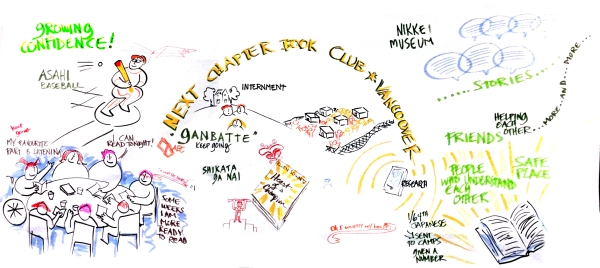
We have been very busy with reading our current book, Heart of a Champion, and two special events: a trip to the Nikkei National Museum and Cultural Centre in Burnaby, and an evening dinner with visiting professor, Dr. Chris Kleiwer.

Our current book takes place in 1941 in Vancouver. The story is about a Japanese-Canadian family. At the Nikkei Museum we learned about the way the Canadian government treated Japanese-Canadians and the tragic history of internment camps. There were lots of photos about what life was like back then. We saw a model of a camp, just like the one the Sakamotos (the family in our book) were sent to in New Denver. There was even a baseball field at the internment camp. Our museum guide took us to the back and showed us an Asahi baseball uniform. The Asahi were a winning baseball team in the 1940s that were great at bunting and played “brain ball” and won many games. At times our book is depressing, but at the museum we learned that people survived at the internment camps by keeping each other’s spirits up. We also learned that people of all ages played baseball at the internment camps.

The museum also had an exhibit of Japanese-Canadians who fought in World War I. We saw women wearing kimonos and practicing their dance routines, origami crane art and photos of the fishing boats in Steveston.
The visit brought the book to life. We would like to go back to the museum, and even visit Japan one day! We really think others would enjoy going to the Nikkei Museum.
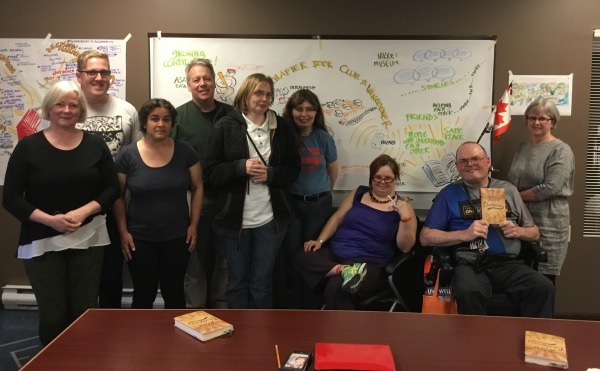
Our evening with Dr. Chris Kleiwer was lots of fun. He did not know about Next Chapter Book Clubs so we explained how the group works. We read our book and showed Chris how we read and talk about a book. We ate pizza, talked about the plot of the book – the Sakamoto family who were now living in a shack at an internment camp and what was happening to Japanese-Canadians in the 1940s. This was new information for Chris. Liz and Aaron drew our conversation. We think sharing about Next Chapter Book Clubs is important, particularly to small communities who may not know of our existence. We discussed the educational challenges that many people with disabilities face. It would be great if someday all kids with disabilities were in classes with their peers, where everyone is equal regardless of ability. Next Chapter Book Club shows others that we are capable of learning.
If you are interested in joining Spectrum’s Vancouver Next Chapter Book Club there are sometimes spots available, usually when participants are moving from one book to another. Please email aaron@spectrumsociety.org and I will get you in touch with the right people!
Next Chapter Book Club in Vancouver
 We are members of the Next Chapter Book Club in Vancouver. We thought you would be interested in hearing about what we are reading and doing these days.
We meet every Thursday evening from 6:30-8pm at the coffee house The Grind in Vancouver. There is a bus stop nearby so it is easy to get to by bus. Spectrum Society for Community Living supports our book club and buys the books we read. When we finish a book we can keep it or donate it.
We work together as a team to read and talk about books. We read out loud to each other. If someone gets stuck on a word we help them out. We stop every once and awhile and talk about what we have been reading. We also look up words and pictures to help us understand what we are reading.
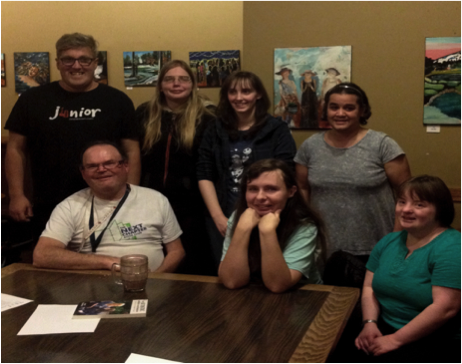
(members with the author Jenny Story)
When we finish a book we have a celebration. We have
- watched a movie at a member’s home and eaten popcorn
- eaten fish and chips while we played the board game Clue
- created bamboo weavings with an artist
- eaten at a Greek restaurant (yes we like food!)
- and had a question and answer session with the author Jenny Story.
Our next book is “Heart of a Champion” by Ellen Schwartz. It is an historical novel about a Japanese baseball team here in Vancouver. The author lives in Burnaby and we hope to have her come and talk to our book club.

We have just started a pen pal project with another book club. We are hoping to get together with them once and awhile.
It’s good to be part of a book club. It gets you out spending time with friends. We all like getting together and have become better friends with each other. It’s good for your imagination!
We are looking for 1 or 2 new members for our book club. If you are interested please contact Judy at our office, 604-323-1433, or aaron@spectrumsociety.org
A Week with David Pitonyak

It’s always a pleasure to draw for David Pitonyak, one of my favourite colleagues, friends and speakers.
On Monday we hosted David Pitonyak for a workshop with Home Share providers and others who choose to share their lives with folks with support needs focusing on The Importance of Belonging – in a recent provincial exploration of these models one of the things that kept coming up was the desire to have more training specifically for folks who do this, where they could meet and talk to each other. The feedback was great! Sketchnotes from the day:


On Tuesday we worked with David and a small group of leaders on clarifying Spectrum’s strategic plan – a method we’ve been really pleased with since we began focusing on action oriented, communicable goals. We looked at it in relation to David’s Toolbox for Change, a workshop we brought him in for previously, that we’ve all been talking about since. Graphic facilitation notes:


On Thursday we spent a last day with David and a group of about 90 folks, talking about “Beyond Behaviours: Supporting Competence, Confidence and Well-being” – more good conversations!
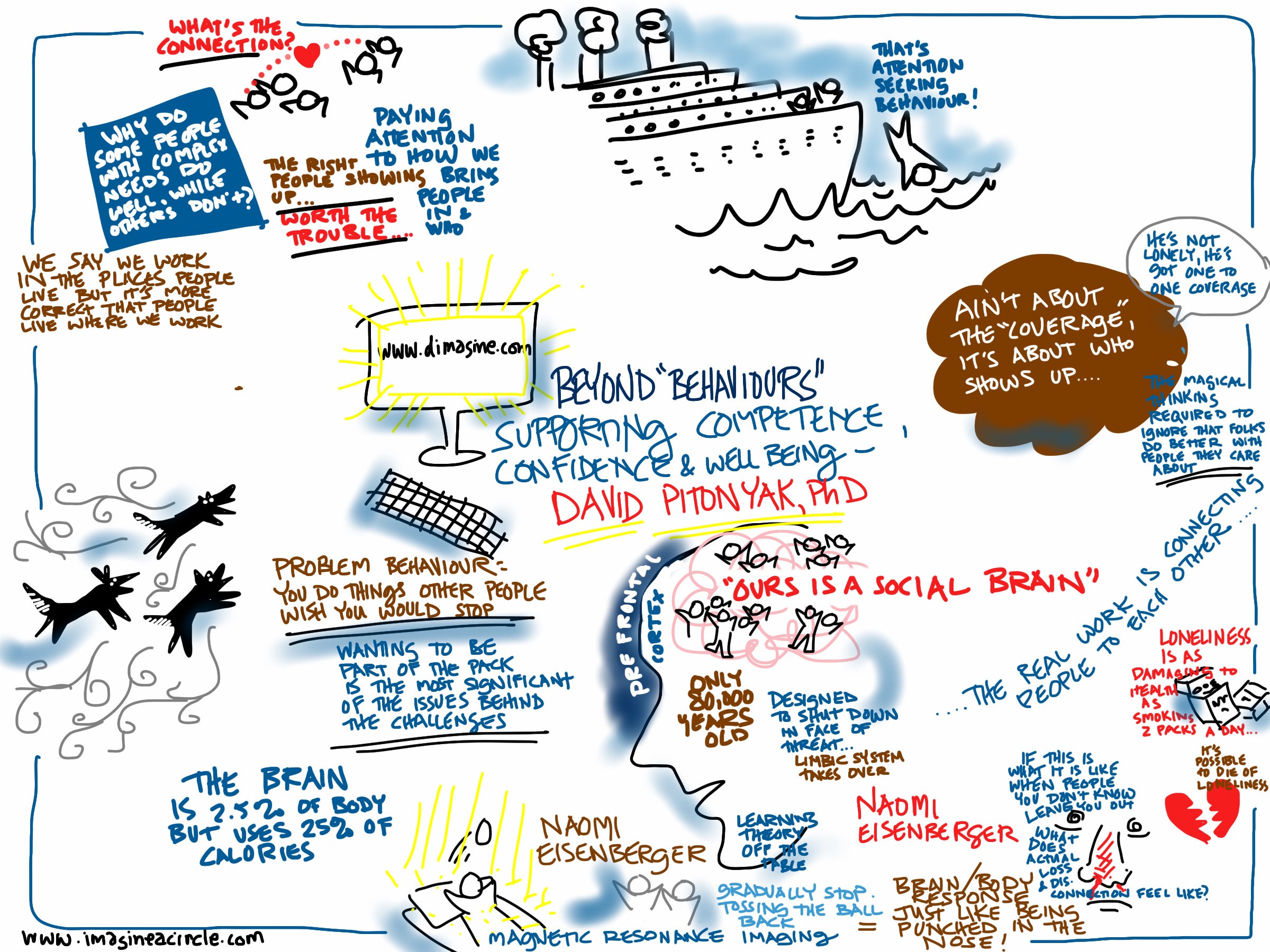

As always, David reminds us to take care of each other. There are things to do, ways to be, plans to make but, really, it’s all about being members of a pack and taking care of each other.

 In November we have three events related to person centered planning, graphic recording and facilitation with two more coming up.
MAPS and PATH Training in Vancouver, Wednesday, 18 November to Friday, 20 November, from 9 – 4. Shelley and Aaron will be joined by some special guests for three days of hands-on training and great conversations.
Expanding Graphics for Person Centred Planning and Thinking with Aaron Johannes, on Saturday, 28 November 2015 from 9:30 AM to 4:30 PM in Vancouver.
Facilitation! Tips and Techniques with Shelley Nessman. Date TBD.
Community Centres, Neighbourhood Houses and Other Places of Belonging are Waiting for You! Join Geri Briggs to learn about what’s available and make a plan to get out more, meet new friends and contribute! Date TBD.
“A deep sense of love and belonging is an irreducible need of all people. We are biologically, cognitively, physically, and spiritually wired to love, to be loved, and to belong. When those needs are not met, we don’t function as we were meant to. We break. We fall apart. We numb. We ache. We hurt others. We get sick.”
Brene Brown
Photo by Ehsan Khakbaz H.

What Can People Come to Mean to Each Other. Graphic by Shelley Nessman and Sheldon Schwitek
I recently spent some time with Tom Kohler – Executive Director of Chatham Savannah Citizen Advocacy and Tim Vogt – Executive Director of the Starfire Council of Cincinnati Ohio as they co-presented about “The Possibility of People”.
A key question that they asked was “What can people come to mean to each other?” As I sat with my colleagues pondering this fundamental question for the work that we do with the people we support, it occurred to me that we often are asking some very different questions:
- What will we do today?
- Where can I support this person to find a job?
- Is this person safe, healthy, happy?
Now don’t get me wrong- these last three are important questions but if we don’t take a crack at that first question on a daily basis- we are likely missing a significant thread in our work, that of honouring the person’s gifts and capacities and puzzling through the idea that the world is waiting to know and love this person so what are we waiting for?
Tim talked about the 5 Valued Experiences which are foundational to the work at Starfire.
The 5 Valued Experiences
- Sharing Places – People sharing the ordinary places of community life at the same time and in the same way as others helps them be seen for their gifts and passions.
- Making Choices – Choices big and small, in all areas of one’s life, lead to possibilities and opportunities to grow.
- Making Contributions – Attaining valued roles that use our gifts, talents, passions, interests, ideas and opinions are all ways to make contributions.
- Growing in Relationships – Taking time to develop a wide, diverse range of relationships with people to grow stronger in our relationships.
- Experiencing Respect – Being seen as a valued person who has positive roles to play in other people’s lives by putting our best foot forward.
They also talked about the ways in which we must let go of old ideas and ideologies to make room for the emerging future for citizens. “What has to die to make room?” inspired much talk around the room as people committed to let go of their fear of change or other negative influences in their work to make more room for their vision for a future that includes all people in an authentic way.
Next time you are with the people you support or your colleagues or even your mom… ask this question “What can people come to mean to each other?” See what happens! Let us know what people tell you… we would love to know!
”All citizens have better life chances, and everyone’s world grows more interesting, when communities offer rich opportunities for all people to have these five valued experiences.” – John O’Brien and Connie Lyle O’Brien
Parker Palmer on finding institutions…
 This great article came to me via colleagues – Parker Palmer on “A New Professional: The Aims of Education Revisited.” In this he is writing about education and medical institutions, but the ideas are easily transferable to our field… if we dare.
One of the things he writes is,
. . . as Ivan Illich reminded us 40 years ago, the functions of a profession are not necessarily those of the institutional structures that house it. The fact that we have schools does not mean we have education. The fact that we have hospitals does not mean we have health care. The fact that we have courts does not mean we have justice. We need professionals who are “in but not of” their institutions, whose allegiance to the core values of their fields makes them resist the institutional diminishment of those values.
I’m a sucker for Palmer. I love his gentle, appreciative, dialogic, Quaker based approaches. But in this article, he’s pissed. How do we send students (or staff) to “work in institutions that too often prove toxic to their deepest commitments.” It’s one of my favourite moments in workshops, where we get to remind each other of the emancipatory intentions that brought us into this work, before we got caught up in a world of boxes to tick off and forms to be filed.
Of how meeting people with disabilities and realizing that what we’ve been told about them in the media and in our cultural stories and even in our textbooks isn’t true – they are not dull-witted, necessarily concrete thinkers, boring, needy, and all those other things that a lot of the messages about them convey – potentially radicalizes us. If what we’ve been led to believe about these folks – who show up at our doors with cakes to share, remember our birthdays, remind us of the things we’ve forgotten in the most gentle appreciative ways, point out that blue socks don’t go with a black suit, faithfully bring us valentines each year (this may just be my own list and if you have friends or family with disabilities you will have your own amazing list) – are some of our most valuable community members: what else might not be true? What else are we in danger of throwing away?
Parker J. Palmer, A New Professional: The Aims of Education Revisited, November-December 2007. Change: A Magazine of Higher Learning.
David Pitonyak – in Burnaby, October 26th and 29th
 We’ve enjoyed our work with David Pitonyak so much over the past several years – a series of talks, workshops, discussions of our strategic plan and case studies for more complex folks. Given that so much of our support has transitioned to Home Share or Shared Living models, as it has around the province, we’re really excited about this upcoming conversation which we’ve organized in response to some of the folks we met in our Home Share Conversations project last year. This event is designed for those who share their lives with people they care about, and hopes to give them time to meet, talk and question. Some tickets still available for both events; lunch included.
One of the things we like is that working with David allows us to engage in a new conversation about complex and challenging situations. His background in behaviourism and the understanding he’s come to over some decades of travelling the world and hearing and being part of many people’s stories allows him to share a rare expertise. That he’s a masterful story-teller makes it all even easier to listen to!
Reduced rates for both events for agency teams of 5 or those affiliated with PLAN, the Family Support Institute or British Columbia’s teachers and other instructional staff in schools and colleges.
Questions? Please contact Judy Smith jwong@spectrumsociety.org or phone (604-323-1433).
Information on Voting in the Federal Election!
Make sure your voice is heard!

People First Canada’s president, Kory Earle, encourages everyone to get out and vote saying:
I want to especially encourage people with intellectual disabilities to vote. It is our right and we should use it. Many advocates who came before us worked hard to make sure that right was protected in the Charter of Rights and Freedoms.
But I also want to do more than that. I want to encourage people to be aware of what is happening in their communities. I want people to find out who their candidates are and what they stand for. I want people to be informed and involved and to use their voice and their vote this October.
I encourage you to get ready, get registered, and get your voice heard in October.
Elections Canada has a great website that:
- allows you to see if you are registered to vote
- lists identification requirements to vote
- lists advance polling dates
The Canadian Association for Community Living has developed a summary of the key issues that are important to People with Disabilities and their families – Inclusion Matters.
All Candidates’ Meetings give you an opportunity to hear directly from candidates why they think they are the best choice to represent you in Ottawa. Getting a chance to say hi and shake their hand can be helpful in deciding who you want to vote for.
Upcoming Meetings: (send us any meetings you hear about and we’ll add them to this list)
- Vancouver East
- Wednesday, Sept 23, 2015 – 7pm – Longhouse Church, 2595 Franklin Street
- Vancouver Kingsway
- Vancouver South
- South Surrey White Rock
Additional Resources:
- Website Quizzes that help match your priorities to the platforms of parties:
David Pitonyak in Burnaby
 Two upcoming events with David Pitonyak.
David Pitonyak: Beyond “Behaviors”: Supporting Competence, Confidence, and Well-Being on October 29th and For Shared Living Folks: The Importance of Belonging on October 26th.
David is an inspiring speaker and story-teller who always gives us new perspectives on our work and helps us connect with what else is happening around the world as he brings back news from his travels.
Please consider joining us. Discounts for FSI, B.C. People First, TASH and PLAN members and staff. Group rates for agencies who want to participate as a team.
For more information contact shelley@spectrumsociety.org or aaron@spectrumsociety.org
99 Cents worth of Community Development
The smallest unit of community is the circle of friends. There are many people talking these days about convening – how does one “host” and “convene” and “facilitate” a group that will come together to share an interest?
Joe Erpenbeck, past Director of Building Caring Communities, a PosAbilities project, had an eye for opportunities and the gaps that might be filled by what he talked about as community acupuncture – where might one insert the point that would create the relief out of which people would come together, talk, share, start to smile at each other and think of things they might do together.
On the stumps in front of his house, he placed animals:

As children walked past with their parents, they would stop to do things. Pile the animals on top of each other. Organize tableaux in which different animals were leaders or followers. Group the animals into new configurations. The baby frog rides the mommy frog…

Months after Joe’s departure, the animals continue to entrance children and their parents. I saw them the other day and they’re either all still there, or their may be new additions. And a mystery. I don’t even remember seeing a hippotomus, but apparently there was one, and now….
 She is gone!
Imagine the fun of someone making this careful, beautiful poster, adding to the accruing stories on the stump, even though Joe and moved back to the U.S.
What have you done that was inexpensive and created gatherings of like-minded people who began to be friends?
P.S. see update from Rebecca at bottom of page
Thanks to Rebecca Pauls for the photos.
Thanks to Joe for permission to talk about his work.

Aaron, Liz Etmanski and Joe, after a great day with community representatives from all around the province, talking about what was making a difference where they lived.
Update.
You may have heard that Vancouver was recently hit by a big windstorm. Luckily, Woody came by to check and make sure everyone was okay!

However, no sooner had things got tidied up than…. ka-boom! a meteor landed! Rebecca will keep us posted on further updates!
Two PATH training options: Vancouver or Victoria! Hmmm….
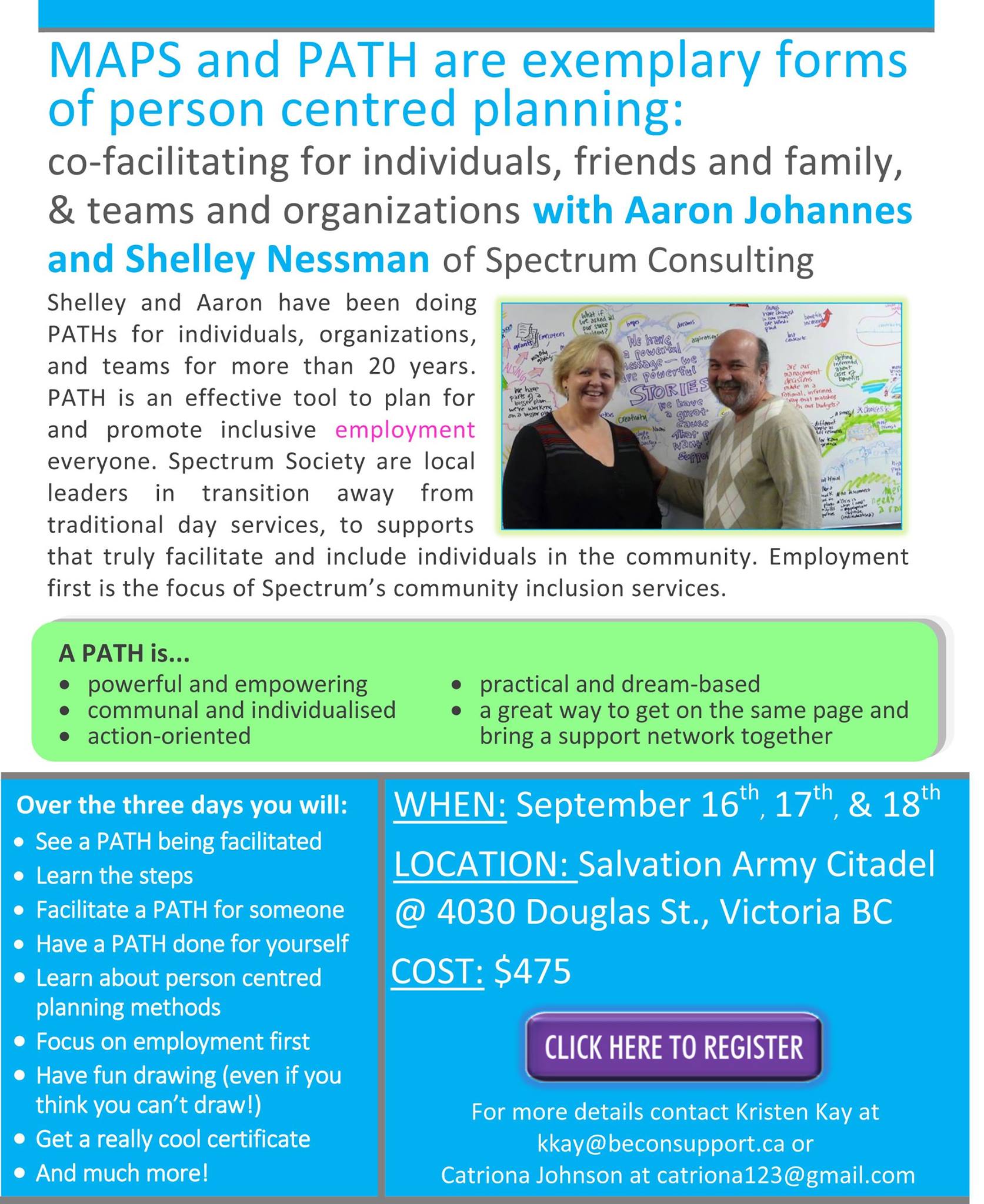
Agencies in Victoria are hosting us to do PATH training September 16 – 18th. Find out more here. For the first time we are looking at how PATH can be used for supported employment.
Or, in Vancouver in November, come spend three days with people who speak “person-centered” 🙂
Upcoming Training Events with David Pitonyak
We are excited to once again be hosting David Pitonyak for a week in October!  David Pitonyak for Shared Living Folks: The Importance of Belonging
Monday, 26 October 2015 from 9:00 to 4:00

- Determining what people may be communicating through their difficult behaviors;
- The role of physiological or psychiatric needs in the development of difficult behaviors
- The importance of asking critical quality of life questions in building a support plan;
- The critical importance of addressing caregiver needs in the development of a support plan;
- Ways to support an individual in crisis.
Training in MAPs, PATH and graphics – new events!

Cheryl’s 2nd PATH, in 2014 (friend David Wetherow is on the laptop screen)
November 18 – 20th, Vancouver. MAPS and PATH as exemplary forms of person centred planning: co-facilitating for individuals, friends and family, teams and organizations
Aaron Johannes and Shelley Nessman with special guest David Wetherow
What is MAP or PATH planning?
“I know I speak for us both when I say that we LOVED the PATH and MAPS training. We were both buzzing about it on our way home . . . ! What valuable tools in person-centred planning. We learned a great deal from the knowledge in the room as well. . . . I am so looking forward to using PATH with individuals. Thank you both so much for generously sharing your knowledge with us. We are very privileged to be working in the community inclusion field with both of you! :)” PATH trainees
PATH is a process in which a facilitator and a graphic facilitator work with a focal person (or organization or team) and their supporters to create a vision of the best possible future, out of which comes a plan that is always “positive” and “possible,” understood by all and no longer mysterious or scary. By the end of the PATH event the focal person or group has communicated where they want to go, what and who they need to support their journey, and how this part of their lives will be part of a bigger future. Those who care about them often say they feel clear, inspired and hopeful afterwards, and are excited to take on action oriented roles. A PATH is a great tool to bring a network together and the “new” PATH processes focus on the development of support networks more than ever!
Shelley and Aaron, together and with other partners, have been doing PATHs for individuals, organizations and teams for more than 20 years and it is still a process that surprises and delights them as they watch individuals and teams who think they hate “planning” come to life and families get excited about the future.
“Oh it’s so gorgeous! What an amazing experience. I feel very privileged to have been part of it. Thank you everyone!” Comment from a teaching staff after being part of her first PATH.
For tickets to this event, click here.
If you would prefer to take this training in Victoria in September 16 – 18th, please contact Kristen KKay@beconsupport.ca or Catriona catriona123@gmail.com.

November 28, Vancouver. Expanding Graphics for Person Centred Planning and Thinking

By Liz Etmanksi: Susan Powell presents to the National Next Chapter Book Club Conference
On April 16-19, 2015, Liz, Jerry and Susan from Vancouver’s Next Chapter Book Club participated in the Chapter’s Ahead Conference in Chicago. This conference is a gathering of Next Chapter Book Clubs from all over North America that come together to learn from each other, share stories and celebrate successes! This year, Liz and Jerry became trained as Co-Faciliators and also made a presentation to the conference about how our group is using graphics to enhance emergent literacy. Aine and Rebecca also came along to the conference to be trained in how to facilitate Next Chapter’s Jot-it-Down Writing Clubs.
During the conference, there were many ways to get involved. Jerry and Liz enthusiastically participated in each of the live book club sessions. Jerry shared ideas from the Vancouver book club, like taking notes about the story line as it progresses and writing summaries at the end of each night. Other people at the conference appreciated the creativity and also liked the idea about bringing an iPad along in case the group needed to look up any new vocabulary words. Liz learned a new strategy called “echo reading” to help everyone in the book club have a chance to read out loud to the rest of the group. In echo reading, one person says each word quietly while another person speaks it out loud to the group. The person that Liz was practicing with was visibly pleased for the opportunity to contribute and add his voice to the reading. Throughout the event, the Vancouver book club was mentioned several times in conversations and presentations. Dr. Fish, the founder of the Next Chapter Book Clubs even said that he would like to come and visit and help spread the word about these book clubs throughout BC and other places in Canada.
After each of the conference days, the group also had a chance to explore and experience the sights and sounds of the big, windy city. Everyone had a chance to have a Chicago Style Hot Dog and lots of deep dish pizza. There was also a chance to do an Architectural Boat tour of the lake and river. It was astounding to see the tall and beautiful buildings that make up the Chicago skyline. Chicago is a friendly, accessible and extremely hospitable city!
The Vancouver Next Chapter Book Club would like to thank Susan Powell and Debby Simcoe for sharing their passion for reading as they facilitate book club each week.
We are also grateful to Spectrum Society for Community Living and all of the generous people who made donations and the Read-a-Thon and Bowl-a-Thon.
Writing facilitated by Rebecca Pauls (Thanks!)
Aaron: it’s been great to hear about the Chicago adventures and how excited people are about reading and, now, writing. The Spectrum Vancouver NCBC has just finished another book and is making plans for the summer, which hope to include some writing events. If you’re interested please email aaron@spectrumsociety.org and I’ll get you in touch. We do appreciate the enthusiasm and hard work of Dr. Powell and Debby Simcoe, and also of Rebecca Pauls, who went along for the ride, was endlessly helpful and organized. Thanks! If you’d like still like to make a donation to our literacy in community work with adults, please feel free to visit our donation site. Just choose “adult literacy programs.”
Finally, a little feedback to Chicago and this means you Brandy Agerbeck – people loved your city and not only how helpful Chicagoans were, but how respectful and simply kind. Also, the food 🙂
Want to see the powerpoint of our presentation? Click here: NCBCChicago2015Smaller
Inclusion B.C. Conference – we had a great time!

So much to say about this – we all had so much fun and learned lots, and maybe later we’ll have time to write about some of the specific workshops we did. In the meantime, here’s a slideshow of some of the six sessions we and our Spectrum Consulting friends were part of producing and hosting.
Allow a minute or two for the pictures to load!
Also, thanks Gary Rosenberg for manning our book table! So much fun to meet so many people who love our work. And thanks, too, to our new friend Justin, on the left hand side of the table.

Training in MAPs, PATH and graphics – new events!
Cheryl’s 2nd PATH, in 2014 (friend David Wetherow is on the laptop screen)
November 18 – 20th, Vancouver. MAPS and PATH as exemplary forms of person centred planning: co-facilitating for individuals, friends and family, teams and organizations
Aaron Johannes and Shelley Nessman with special guest David Wetherow
What is MAP or PATH planning?
“I know I speak for us both when I say that we LOVED the PATH and MAPS training. We were both buzzing about it on our way home . . . ! What valuable tools in person-centred planning. We learned a great deal from the knowledge in the room as well. . . . I am so looking forward to using PATH with individuals. Thank you both so much for generously sharing your knowledge with us. We are very privileged to be working in the community inclusion field with both of you! :)” PATH trainees
PATH is a process in which a facilitator and a graphic facilitator work with a focal person (or organization or team) and their supporters to create a vision of the best possible future, out of which comes a plan that is always “positive” and “possible,” understood by all and no longer mysterious or scary. By the end of the PATH event the focal person or group has communicated where they want to go, what and who they need to support their journey, and how this part of their lives will be part of a bigger future. Those who care about them often say they feel clear, inspired and hopeful afterwards, and are excited to take on action oriented roles. A PATH is a great tool to bring a network together and the “new” PATH processes focus on the development of support networks more than ever!
Shelley and Aaron, together and with other partners, have been doing PATHs for individuals, organizations and teams for more than 20 years and it is still a process that surprises and delights them as they watch individuals and teams who think they hate “planning” come to life and families get excited about the future.
“Oh it’s so gorgeous! What an amazing experience. I feel very privileged to have been part of it. Thank you everyone!” Comment from a teaching staff after being part of her first PATH.
For tickets to this event, click here.
If you would prefer to take this training in Victoria in September 16 – 18th, please contact Kristen KKay@beconsupport.ca or Catriona catriona123@gmail.com.
November 28, Vancouver. Expanding Graphics for Person Centred Planning and Thinking
Upcoming Training Events with David Pitonyak
We are excited to once again be hosting David Pitonyak for a week in October! David Pitonyak for Shared Living Folks: The Importance of Belonging
Monday, 26 October 2015 from 9:00 to 4:00
- Determining what people may be communicating through their difficult behaviors;
- The role of physiological or psychiatric needs in the development of difficult behaviors
- The importance of asking critical quality of life questions in building a support plan;
- The critical importance of addressing caregiver needs in the development of a support plan;
- Ways to support an individual in crisis.
How to Find Your Way Back Home By Aine Rathwell
I really liked this story when I heard it – anyone can find their way some places, some times, but it’s a great lifeskill to get lost and find your way home. I asked Aine if she’d write it up and allow me to share it. Thanks Aine! Aaron
 I recently moved to a new neighbourhood. It is a nice neighbourhood and very beautiful right now with all of the cherry blossoms in full bloom. The street reminds me of England.
It has been fun to get to know all of the new little shops and restaurants around here. One of my favourite things to do is go out and treat myself to nice meals. Unfortunately, the first time that I ventured out on my own I got lost.
 Before I left the house, I thought that I had my cell phone, and the notebook that has emergency numbers and addresses. I planned to go and get some sushi at the place near the corner and then afterwards walk back to my new place with someone I know very well.
Well, I had my sushi and then could not find my way back home. I tried to remember the basic directions but I ended up lost in the city and could not find my way. Turns out I didn’t have my cell phone or my notebook. I couldn’t even find a place to stop because I didn’t know who I could call.
 It feels like I was walking all day. Thankfully I was not cold and I had just eaten a nice meal. Finally I found a place of business to talk to and they let me use their phone free of charge. They helped me to look up a phone number to call and then printed out a map for me.
As I was walking back, I got confused again and stopped to ask someone to help me figure out the map. Then to my delight, a car came up and finally I got a ride back from my room mate. I am safe at last and learned some valuable lessons.
 Next time I go out, I am going to check the following:
- – Make sure I have my cell phone and that it is fully charged
- – Update my cell phone with important numbers
- – Bring my notebook that has information like my new address in it
- – When I am out with other people, pay attention to the names of the streets
Social Media Citizenship “Please leave your cell phone on!” Connected and Included: why it matters
Always one of our favourite presentations and such a pleasure to work with Doug Tennant who brings so much to our field. Here are some photos of participants creating little models of social media with pipe cleaners – below that is the presentation, which you can download from slideshare 🙂
Here is the link to the Diigo Social Media for Social Good links 🙂
 101 Ways to Make Friends